|
Educating the Class of 2030 |
Please |
|||
| 1. Economic Principles Lead to Shorter School Day, Year Round School, Economic Efficiency, Employable Students | ||||
|
Our Goal
1) Applying the economic law of
Diminishing
Returns (applying a variable resource like
education to a fixed resource like the human brain eventually leads to diminishing
production like learning)
and 4) Teaches flexibility results as teaching only sixteen courses yearly would allow for teaching additional courses for extra pay. This would be encouraged and teaching an unpaid overload to accumulate leave time would be an earned privilege. For example a teacher earning $64,000/year for a morning shift or $4000 per course might teach an overload afternoon course for $2000. Four teachers doing this would save half a salary for society. 5) Economic use of facilities
as two
sessions would solve housing problems. The potential cost saving for large
school systems making maximum use of their facilities are unlimited. Core Intelligence centers on
mathematical-logical and verbal intelligence.
Special Intelligence is the above average ability in any of the eight areas of multiple intelligences. Examples include Mathematical, Spatial, Bodily Movement, Musical, Verbal, Interpersonal, Interpersonal, Naturalist The world of work rewards people who develop skills associated with their special intelligence provided they have the minimum core intelligence skills required by their profession. In the words of John Dewey, ..."to prepare him for the future life means to give him command of himself; it means so to train him that he will have the full and ready use of all his capacities" (My pedagogic creed, Dewey, 1897 Wiki). 7)
Grades one to eight should concentrate on determine and exploring a
student's special intelligence while bringing their core intelligence up to an
acceptable minimum. Editor's Note:
This should be a fun time and not the rigor of some Asian countries and Tiger
Mothers of the United States.
It won't work and just causes anxious
unhappy students! If you must test, comparison to those in the students
state or county would limit the negative affects of self esteem.
See
No Grades/Homework 12) Page 2 of The Quick Notes Philosophy was the bases for much of this dissertation.
|
Sources:
Global Economic Intersection,
The Economist,
Seeking Alpha
Part 2
How Germany, Our Chief Competitor,
Part 3
Part 4
Appendix 1 Advantages of Proposed Change Ambitious Students could take courses in both session or use the time to participate in projects like First Robotics Competition, First Tech Challenge, and First Lego League. P-Tech uses the extra time to help students earn an associate's degree while earning a U.S.. diploma, all in four years. This system would be advantageous for vocational HS as it provides time for students to work. Two talented students might even combine for a full time job. A lower minimum wage for part time students not requiring payroll taxes would help. Sports would benefit as one sport might go in the morning and practice in the afternoon and a second sport would do the opposite thus making much better use of facilities. Two varsity sports might constitute a course. My friend Paul is happy. School systems could retire
older facilities and free rooms could be rented to people wanting to run
morning and afternoon day care for working parents.
Appendix 2 The Effects of Summer Vacation on Achievement Test Scores: A Narrative and Meta-Analytic Review Source
Abstract"A review of 39 studies indicated that achievement test scores decline over summer vacation. The results of the 13 most recent studies were combined using meta-analytic procedures. The meta-analysis indicated that the summer loss equaled about one month on a grade-level equivalent scale, or one tenth of a standard deviation relative to spring test scores. The effect of summer break was more detrimental for math than for reading and most detrimental for math computation and spelling. Also, middle-class students appeared to gain on grade-level equivalent reading recognition tests over summer while lower-class students lost on them. There were no moderating effects for student gender or race, but the negative effect of summer did increase with increases in students’ grade levels. Suggested explanations for the findings include the differential availability of opportunities to practice different academic material over summer (with reading practice more available than math practice) and differences in the material’s susceptibility to memory decay (with fact- and procedure-based knowledge more easily forgotten than conceptual knowledge). The income differences also may be related to differences in opportunities to practice and learn. The results are examined for implications concerning summer school programs and proposals concerning school calendar changes." Appendix 3 Fix public education
immediately.
Please
E-mail
or
antonw@ix.netcom.com
|
|||
|
From Parts 1-3 We Have a Bottom Line |
|
|
Our Most Educated Generation Has No Savings Chart Urban Institute |
Large Debts
|
|
Most Have Poor
Job Prospects as Only Our
|
|
![]() |
|
![]() |
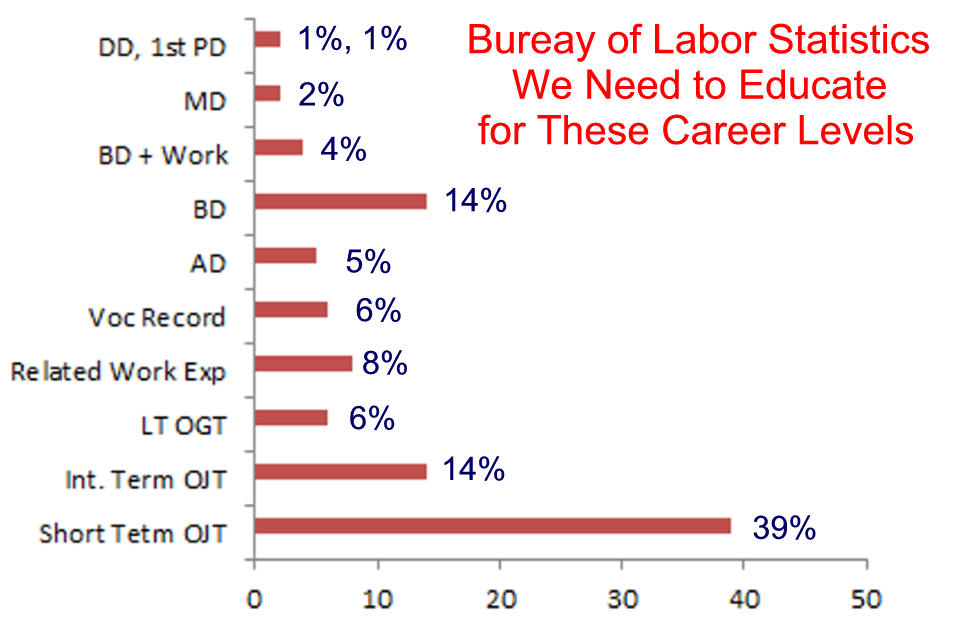
All Because Education is directed toward college and not employment. Increase in the Supply of College Graduates Does Not Create Demand for College Graduates. Goal of Academics and Publishers is to Make Money. The Bottom Line Bright Students Are Serviced but Face Severe Competition. Most Students Are Not Well Prepared for Work/Life Please
Please E-mail
or
antonw@ix.netcom.com
|
|
Staying Current 7) Head Start Doesn't Work A recent Opinion article in the Villages retirement paper picked up
an editorial featuring the reported 2010 Head Start Impact Study
that stated thee and four year olds participants in Head Start were no
better prepared for first grade than non-participants. This is the nth
such article/report I've read in thirty years. There have been many
studies and none have shown Head Start improves academic performance.
The normal curve rules and those who think it can be changes will
have to wait for generic engineering. But the normal curve applies to
other important characteristics and it is these our education system
must foster. Data from Iceland indicates that younger students in a class do poorer in standardized test through seven grades and other studies have shown that 10% of younger HS graduates go to college. The Economist, 12/7/12, p21 Watch Videos
and Understand
E-mail
or
antonw@ix.netcom.com
the retired teacher/editor/authorWalter edited and
written by Walter
Antoniotti, |
Sundry Items of Interest 1)
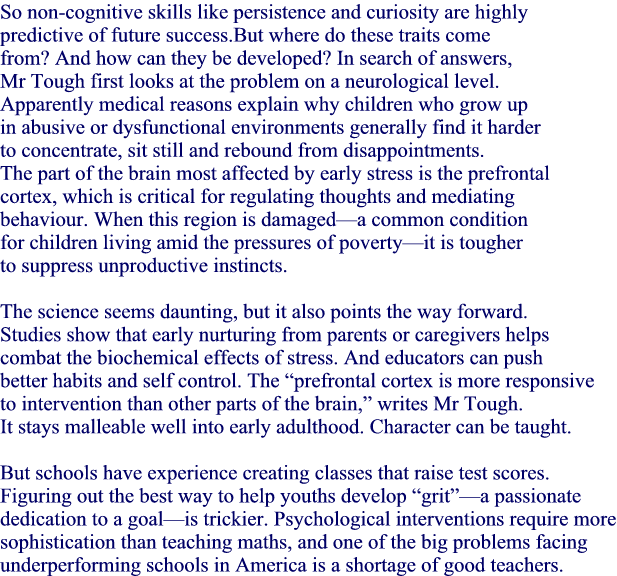
Non-academics students possess
Characteristics of success ![]() 3) Head Start leads to nonacademic value that will lead to economic and social success. 4)
The Wage Affect of Offshoring examines
data from Denmark to look at the connection between globalization,
inequality and the value of a college degree. “With stagnating wages and
lingering unemployment, income inequality is back in the headlines. Is
globalization to blame for this inequality? Is more education a solution?
This column argues that focusing
on university education misses important effects. It presents evidence
that wage effects vary markedly among those with degrees depending on
their specific skill sets, and that globalization can often benefit
workers without degrees.” 5) Tradable goods are producing high paying jobs that require more education Germany does best at manufacturing tradable goods. She is avoiding high unemployment with job sharing, called discussed unemployment. I'm betting the recovery will bring back higher wages but hours work will stayed reduced as robots and computers do the work Return to Class of Educating 2030 Please
|
|
Appendix 4 |
||
|
An attempt to learn about the real estate business brought me in contact with Joan, middle aged women who had been a million dollar salesperson in her first year. She was well dressed, attractive, very ambition and had a talent for selling. Joan was famous for her answer to a question from prospective buyers who were aghast when they saw a foot of water in the basement of a home they might buy. “Well, think how lucky you are to know about the water. Now you can bid $3,000 lower and fix the problem for $1,000. Joan was correct; they bought and were very happy with the property. This was the middle 1970's when new starter homes were small, about 10,000 square feet, had one bathroom, three bedrooms, and cost about $40,000. Joan wanted to be a real estate broker, but fail the test because of her poor mathematical skills. Math required for the license was using formulas, a little geometry, and multi-step word problems. Some of this was necessary for commercial developers but for what Joan wanted to do, little math was needed. But testing is a way to limit supply of brokers thus keeping commissions high. Much of what I did was build her confidence that if she did the easy questions, a missed the few difficult questions, she would still pass. Needless to say, she passed the exam and years later, was still queen of the hill. Joan was one of the most confident people I've encountered in many years of education. She went to school before testing sapped the vitality out of people who were not above average in both mathematic analysis and verbal understanding. Interpersonal intelligence, easily the most important in the real world kind of intelligence, isn't considered important by our academic educators. The Rest of the Story Joan had a secret to her success. She belonged to the Friday 7:00 AM Howard Johnson Breakfast Club. Two or three plus salespeople from ten or so local real estate companies met, talked a little business, and created a network. If you needed something for sale at one of your competitors, you called your friend from Friday mornings. They would call you. The more people you helped, the more people who would help you. I once had the world's greatest house listing, A+ condition, location, and price. Two or three sales were stopped by parents coming to visit. I had guaranteed the owner who was leaving for Venezuela it would be sold and he was nervous, but not me. With two weeks to go I called Joan and agreed to split the listing commission and it was sold the next day. Some people think Joan should go to college, I think school should be designed to maximize her special intelligence. edited 1/21/13 e-mail comments to antonw@ix.netcom.com
|
Battlefield Reflections of a Introduction: After years of traditional teaching I switched to Quick Notes Statistics a programmed type text and its companion Excel Statistics Lab Manual. With all the problems and their data sets written in Excel, much of the calculation requirements were removed as an obstacle to learning. Many students were familiar with the text as they had used Quick Notes Financial Accounting and/or Economics Interactive Class Notes with Links in previous courses. These books were concise two-page outlines per chapter with practice problems and complete solutions. Methodology: Class one began with a 30 minute summary of material covered on the first computerized take-home or in the lab test. We then adjourned to the lab with some of the better students leaving to do the work at their own convenience while the others joined me in the lab learn to use Excel to calculate measures of central tendency. Lectures/lab sessions followed. The class before the computerized test using Excel was a comprehensive hour or so review where I again saw the better students and after the review a few were off to the lab to finish their computerized lab set due before the test. This procedure was followed for tests on probability and on hypothesis testing/correlation/regression. Result: 1) Being an honor system take-home on a computer exam resulted in the same grade distribution as for traditional in class with a large note card exams. 2) More material was easily covered with less work and anxiety. 3) But only the better students learned more, much more. Students, as they had for over 35 years at four different average at best colleges, divided themselves into four groups. Group one never really learned to use Excel to do much of anything and passed with low grades because of easy grading procedures. Group two calculated some statistics correctly but ran into trouble deciding which Excel menu procedure to use for each of the eight different problems on the take home final. I had warned them that grades would go down with each tests, many would be disappointed. Some of these adults worked really hard but having to choose between finite and normal distributions, large and small samples, then between one sample and two samples eventually led to mistakes. Group three often got the statistic correct but then had difficulty determining to accept or reject the no change null hypothesis. All the studying in the world doesn't help because they had never really figured out what hypothesis testing was all about. Group four had one final hurdle, explaining what the answer meant. They had correctly accepted or rejected the null hypothesis but what did it mean? They needed to write in the analysis section that the new procedure was faster or had less defects or the new diet was better or else it was back to group three and a lower grade. Less than six from a class of twenty-five got almost everything correct and got a 4 grade on almost every problem. A very few got everything correct. copyright 21st
Century Learning Products edited and
written by Walter
Antoniotti,
|
Other Stuff Popular but Incorrect Neuromyths' from online.wsj.com/ We use only 10% of our brains. A high stimulus environment improves the brain of preschool children. Using a student's preferred learning style improves learning. The Thousands of Californians Who Failed The Bar Exam Are Going To Hate This Guy is an example of how college can teach them but can't learn them. I wonder if college law schools are required to publish Bar Exams pass rates Data from Iceland indicates that younger students in a class do poorer in standardized test through seven grades and other studies have shown that 10% of younger HS graduates go to college. The Economist, 12/7/12, p21 Watch Videos
and Understand Need Material for this space
|
|
Epilogue: The Cost of a Misdirected Education My Keene State College 1990 Economics 101 class was given data showing that average college graduates make much more than high school graduates. They had seen it before. That is why most of them were in college. Then I showed them median income of college graduates. They were disappointed with the lower number. I explained how some really high earners make the mean higher than the median. Then I showed them data indicating the bottom quarter of college graduates earned about the same income as high school's top-quarter. They became more unsettled. Then I gave them the lowest income statistic of all, median income for those with just a bachelor's degree. Those with higher degrees were left off. From the back of the room I heard "you mean they are ripping us off. It took about twenty years, but I pleased to report that, because of the Great Recession, mass media coverage of the decreasing economic return from a college education is no longer sporadic . But like any unwelcome news, parents, teachers, and politicians will be the last to react properly. The collateral damage has been immense. It will continue to be so unless some responsible mass media helps makes an educational system that improves the well-being of all students . Here is the collateral damage of our love affair with college. College graduates who can't find a job and dropouts owe over one trillion dollars in outstand college loans and are finding they do not have the skills to earn a positive economic return from their investment. Disgruntle U.S. graduates and dropouts whose needs were not met by their investment of many years in school and from whom society receive little support. In fact, many need society's support. But some took the path less traveled. My fourteen year-old nephews announced he wanted to attend a neighboring carpentry high school. Four years of getting up early and getting a ride from his father to grandmother's house where he waited for the school bus to take him to a new, strange school. At fourteen! After school he walked the three miles home from grandma's house. No one told him from anyone, he just didn't like academics and decided on a vocational education. Now a successful small contractor, his biggest problem is convincing his wife they don't need a new Volvo every two years. His younger brother was much more academic, but found school a waste of his lazy, but conniving mind. He dropped out early in the 9th grade, eventually went in the military, kept looking for a good job in corrections until he found a unionized one working for the state. No one had to tell him that investing in a 40K in addition to the state retirement plan was a good idea. He also bought car mortgage insurance a year before not being able to pay said liability. Epitaph: Many of our best and brightest did make a proper investment in college and there are enough of them to maintain our nation's well-being. Imagine a country where the school system maximizes all kinds of all Special Intelligence rather than maximizing the math/verbal intelligence of everyone including those with whose learning disabilities requires special attention. Edited 1/30/13
Older Generations Accumulate, Younger Generations Stagnate
|
More Interesting Thoughts Quotes " The mind is not a vessel to be filled , but a fire to be kindled." Plutarch The Week Magazine 11/02/12 p199 Edited 1/30/13
Early Years Education The Economist Magazine 2/9/13
"Finland on top (it scored direly in the OECD study). At least 98% of children aged five or six are in pre-school education there. Finland also dominates the overall league tables for education performance, so perhaps the scope for improvement is slight. Other enthusiastic providers of pre-school education like Sweden, Norway, France and Belgium and Denmark do not score particularly highly on attainment in later education, whereas Japan, which combines early-years provision with a fiercely competitive exam culture, excels. So too does South Korea, where the state until now has provided under half of pre-school places. So pre-school is no panacea, says Andreas Schleicher, who oversees the OECD’s big triennial PISA report on educational attainment. “Drilling children” in early years does not lead automatically to learning gains, he says."
|
|
GDP and Personal State Tax Burden Per Capita by State Retirement Home Location Guide Provided Tax Data |
Richest/Poorest State GDP/Capita |
||||||||||||||||||||
| territory | per | per | territory | per | per | territory | per | per | territory | per | per | territory | per | per | Rank | State | GDP/ | Taxes |
% Taken |
||
| capita | capita | capita | capita | capita | capita | capita | capita | capita | capita | ||||||||||||
| United States | $47,482 |
50 |
Del |
$69,667 | 3,426 |
8.4 |
|||||||||||||||
| D C | 174,500 | 1 |
|
|
11 | Louisiana | 47,467 | 21 | North Carolina | 42,884 | 31 | Tennessee | 39,730 | 41 | 1 | Miss | $28,,259 | 2,924 | 10.2 | ||
| Delaware | 69,667 | 2 | Calf | 51,914 | 12 | New Hampshire | 47,385 | 22 | Oklahoma | 42,237 | 32 | Michigan | 37,616 | 42 | 2 | Ark | 29,999 | 3,088 | 10.3 | ||
| Alaska | 65,143 | 3 | Maryland | 51,724 | 13 | Nevada | 47,222 | 23 | Ohio | 42,035 | 33 | Kentucky | 37,535 | 43 | 3 | NM | 30,642 |
3,031 |
09.9 | ||
| Connecticut | 64,833 | 4 | Minn | 50,396 | 14 | Texas | 45,940 | 24 | Utah | 41,750 | 34 | Montana | 37,200 | 44 | 4 | Utah | 30,917 | 3,261 | 10.5 | ||
| Wyoming | 63,667 | 5 | ILL | 50,328 | 15 | Pennsylvania | 45,323 | 25 | Georgia | 41,711 | 35 | Arkansas | 36,483 | 45 | 5 | Idaho | 31,031 | 3,139 | 10.2 | ||
| Massachusetts | 58,108 | 6 | SD | 49,875 | 16 | Rhode Island | 45,000 | 26 | Indiana | 41,169 | 36 | Alabama | 36,333 | 46 | States of Interest | ||||||
| New York | 57,423 | 7 | Neb | 49,778 | 17 | Oregon | 44,447 | 27 | Missouri | 41,117 | 37 | New Mexico | 35,952 | 47 | Mass | 49,203 | 5,047 |
10.3 |
|||
| New Jersey | 56,477 | 8 | Hawaii | 49,214 | 18 | Kansas | 44,310 | 28 | Maine | 40,923 | 38 | South Carolina | 35,717 | 48 | Ohio | 36,054 | 4,332 |
12.0 |
|||
| Virginia | 53,463 | 9 | Iowa | 49,067 | 19 | Wisconsin | 44,105 | 29 | Arizona | 40,828 | 39 | West Virginia | 35,053 | 49 | NH | 42,707 | 3,136 |
07.3 |
|||
| Washington | 52,403 | 10 | ND | 47,714 | 20 | Vermont | 44,000 | 30 | Florida | 40,106 | 40 | Idaho | 34,250 | 50 | Fl | 36,734 | 3,566 |
09.7 |
|||
|
![]()
|
|||||||||||||||||||||||||||||||||||||||||||||||||||||||||||||||||||||
![]() |

|
See also Careers Needing Workers and Determining the Economic Return of a College Education e-mail comments to antonw@ix.netcom.com |
|||||||
|
15 most valuable majors |
#3 The 10 Worst Majors |
#4 13 surprisingly-low-paying-jobs/ 2/28/13 Jacquilin Smith
|
|||||
| 1. Major | Salary after 10 years | Major | Salary Grads/ Exper |
Unemployed Grads. 22-26 Exper. 30-54 |
Career | Mean Salary Bottom 10% |
Number Employed |
| 1. Petro Engin | $98,000 $163,000 | 1. Anthropology Archeology |
$28,000 $52,000 |
10.5% 6.2% |
1. Private Detective | $48,610 $26,080 |
26,080 |
| 2. Aerospace Engin | $62,500 $118,000 | 2.Film,Video, Photographic Arts |
$30,000 $50,000 |
12.9% 6.7% |
2. Surgical Technician | $42,460 $28,860 |
94,490 |
| 3. Actuarial Math | $56,000 $112,000 | 3.Fine Arts | $30,000 $45,000 |
12.6% 7.3% |
3. Flight Attendants | $41,720 $24,990 |
87,190 |
| 4. Chem Engin | $67,500 $111,000 | 4.Philosophy/Relegion | $30,000 $48,000 |
10.8 6.8% |
4. Desktop Publishers | $39,030 $21,320 |
18,620 |
| 5. Nuclear Engin | $66,800 $107,000 | 5. Liberal Arts | $30,000 $50,000 |
9,2% 6.2% |
5.Marriage/Family Therapist |
$48,710 $25,230 |
33,990 |
| 6. Elect Engin | $63,400 $106,000 | 6.Music | $30,000 $45,000 |
9.2% 4.5% |
6. Fire Fighters | $47,720 $22,480 |
304,080 |
| 7. Comp Engin | $62,700 $105,000 | 7.Physical Fitness Parks & Recreation |
$30,000 $50,000 |
8.3% 4.5% |
7.Radio/TV Announcers | $40,510 $17,150 |
31,680 |
| 8. Applied Mathematics | $50,800 $102,000 | 8.Commercial and Graphic Arts |
$32,000 $49,000 |
11.8% 7.5% |
8. Embalmers | $$45,060 $27,010 |
6360 |
| 9. Comp Science | $58,400 $100,000 | 9. History | $32,000 $54,000 |
5.8% 5.4% |
9. Reporters Correspondents |
$43,640 $20,000 |
45,270 |
| 10. Statistics | $49,300 $99,500 | 10. Eng. Lang./Literature | $32,000 $52,000 |
9.2% 6.2% |
10. Tax Preparers | $39,410 $18,440 |
59,180 |
| 11. Physics | $51,200 $99,100 | 11. Legisytlators | $$38,860 $16,280 |
62,180 | |||
| 12. Mech Engin | $60,100 $98,400 | 12. Models | $27,830 $15,960 |
2,760 | |||
| 13.Biomed Engin | $54,900 $98,200 | 13.Chefs/Head Cooks | $46,600 $24,770 |
90,300 | |||
| 14. Government | $42,000 $95,600 |
The Sole Purpose of Education
|
|||||
| 15. Economics | $48,500 $44,900 |
The Truth Behind High College Grades |
|||||
![]() From
less than 40% to about 85% A's and Bs NYT 7/14/11 |
|||||||
|
In These Selected Countries Income Was Less Equally Distributed, Some Northern European Countries and Canada Increase $ to the Poor, The US and GB did not! |
|||||||||||||||||||||||||||||||||||||||||||||||||||||||||||||||||||||||||||||||||||||||||||||||||||||||||||||||||||||||||||||||||||||||||||||||||||||||||||||||||
|
|
||||||||||||||||||||||||||||||||||||||||||||||||||||||||||||||||||||||||||||||||||||||||||||||||||||||||||||||||||||||||||||||||||||||||||||||||||||||||||||||||

Back to top hhhhhhhh
|
||||||||||||||||||||||||||||||||||||||||||||||||||||||||||||||||||||||||||||||||||||||||||||||||||||||||||||||||||||||||||||||||||||||||||||||||||||||||||||||||||||||||||||||||||||||||||||||||||||||||||||||||||||||||||||||||||||||||||||||||||||
hh ddd