|
Chapter 27 Demand for Economic Resources |
|
|
I. Resource (factor) pricing significance II. Determining resource prices III. Resource demand is "derived" IV. Determining Resources demand |
VII. Elasticity of factor demand IX. Resource Markets 25 min. Video
Quick Reviews 1-page
per chapter
|
|
Lecture Notes
I.
Significance of resource (factor) pricing significance
|
|
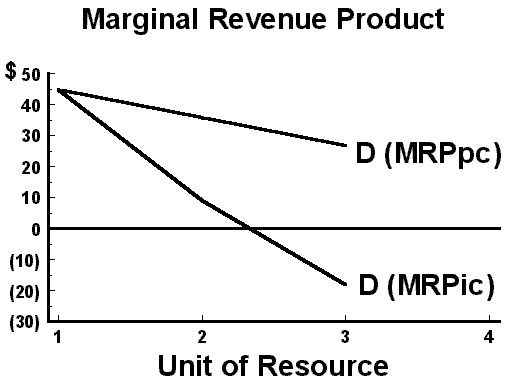
IV. Determining resources demand A. Demand for resources is called marginal revenue product (MRP) 1. Marginal physical product (MPP) is the change in total production which results from hiring one more unit of a resource. 2. Marginal revenue product (MRP) is the change in total revenue which results from hiring one more unit of a resource B. Economics in 60 seconds provides a preview. 1. Video on Comparing Perfectly Competitive Product and Resource Markets Review 2. Econ Concepts in 60 Seconds: Calculating MRP and MRC Review in purely competitive product and factor markets. C. Labor will be the variable resource examined. D. Both competitive and noncompetitive product markets will be analyzed. 1. Perfectly competitive product market |
| Unit of Resource Purchased |
Total
Product (TP) |
Marginal Physical Product of Labor |
Selling Price
of Product Produced (P) |
Total Revenue (TP x P) |
Marginal Revenue Product of Labor | |
| 1 | 15 | 15 | 3 | 45 | 45 | |
| 2 | 27 | 12 | 3 | 81 | 36 | |
| 3 | 36 | 9 | 3 | 108 | 27 |
|
2. Imperfectly competitive product
market |
|
|||||
| Unit of Resource Purchased |
Total Product (TP) |
Marginal Physical Product of Labor |
Selling Price
of Product Produced (P) |
Total Revenue (TP x P) |
Marginal Revenue Product of Labor | |
| 1 | 15 | 15 | 3 | 45 | 45 | |
| 2 | 27 | 12 | 2 | 54 | 9 | |
| 3 | 36 | 9 | 1 | 36 | -18 | |

|
VI. Factor relationships affect demand. A. When resources are substitutes for each other such as labor and capital, they compete for investment dollars. 1. An increase in the productivity of capital will cause the MRP of capital to increase relative to the MRP per dollar of labor. 2. As a result, capital will be substituted for labor. 3. The process of substituting more efficient capital for less efficient labor is called the substitution effect. It began in the Stone Age, accelerated dramatically with the Industrial Revolution and continues to accelerate today. 4. An automated welding machine replaces people making welders less valuable. |
B. When
resources are complements to each other such as labor and |
|
VII. Elasticity of factor demand A. ![]() B. Many factors affecting resource elasticity of demand 1. Diminishing return as the faster diminishing returns begin, the quicker MPP decreases and the more inelastic is resource demand. 2. High elasticity of product demand increases factor elasticity of demand 3. Number and suitability of substitutes increase elasticity. If there are suitable resources available to switch to, firms will switch rather than pay more for a given resource. |
4. Importance of the resource: resources that represent a high proportion of a product's total cost will have high elasticity of demand as the possible cost saving is substantial and the search for a substitute will be intensive. 5. Time increases elasticity: given enough C. 1. Read the American Production and Inventory Control Society (APICS) and learn how they true to increase the marginal physical product of resources and 2. Read Who Did the Ethanol Tax Credit Benefit? An Event Analysis of Subsidy Incidence time, a substitute for expensive resources will be found |
VIII. Individual labor supply
People do not work at extremely low wages because the opportunity cost of leisure, i.e wages, is low and it's not worth working. People begin to substitute work for leisure as wages are increased as the opportunity cost of leisure (wages) is greater and greater. But leisure is a superior good and at some point the income effect causes people to increase leisure and work (supply) less even though wages are increased. As a result, the supply curve will eventually bend back toward the y-axis. For more visit Backward bending supply curve of labor from Wikipedia |
Why is productivity up much more than wages?
epi.org/publication/10-year-decline-wages-college-graduates/ Answer is in the next few chapters.
|